
Camino Real de Las Vueltas: A historic path
“Discover the wonderful trails of Tenerife with our expert hiker Francisco Fariña”
Trails of Tenerife: The Camino Real de Las Vueltas
Index
The Camino Real de las Vueltas is one of the oldest royal roads on the island of Tenerife, dating back to the sixteenth century, although it was probably made on an ancient path that the primitive Guanches had used in order to communicate with the interior of the island; “You will walk on history.”
On the TF-12 road, and immediately after crossing the hamlet of Casas de La Cumbre, in the Anaga Massif, recently declared a Biosphere Reserve, is the forest house of Taganana, in the place called Cruz de Taganana, easy to locate as it is painted a dark red color. Next to it there is a wooden sign showing the route and a fountain where you can collect fresh water.
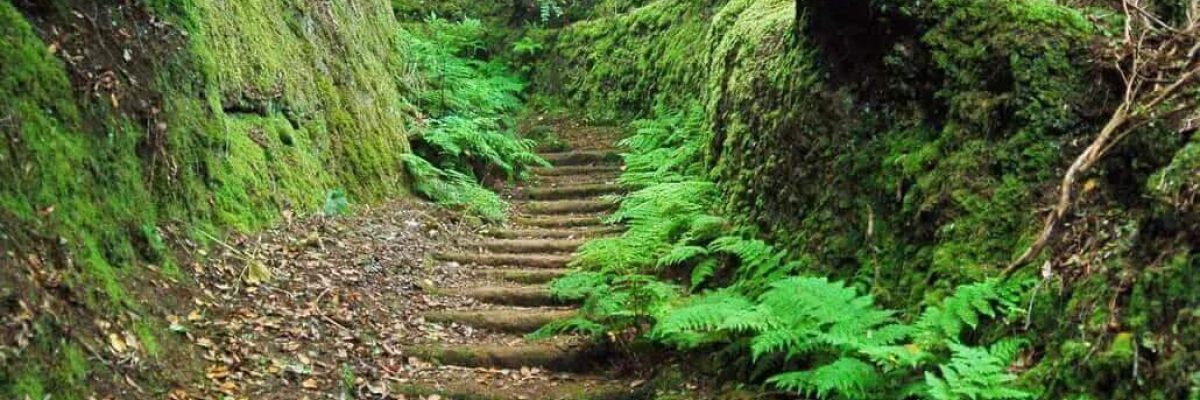
In the same place there is a winding and humid path, as well as a narrow path that gently ascends by stairs carved into the ground that will take us under a lush laurel forest covered with a multitude of ferns, to a small cave drilled into the rock and covered with Canarian ivy that will serve as a refuge for walkers.
According to history, this site was a resting place for people who came from Taganana to the capital of the island, which was formerly La Laguna, therefore it was a place that bustled with life, since merchants, charcoal burners, gangocheras, dairy farmers and farmers met there to sell and exchange their products.
Nowadays there is real silence! It was also said that it was an overnight place for funeral processions that went to bury their loved ones in La Laguna and neighboring towns.
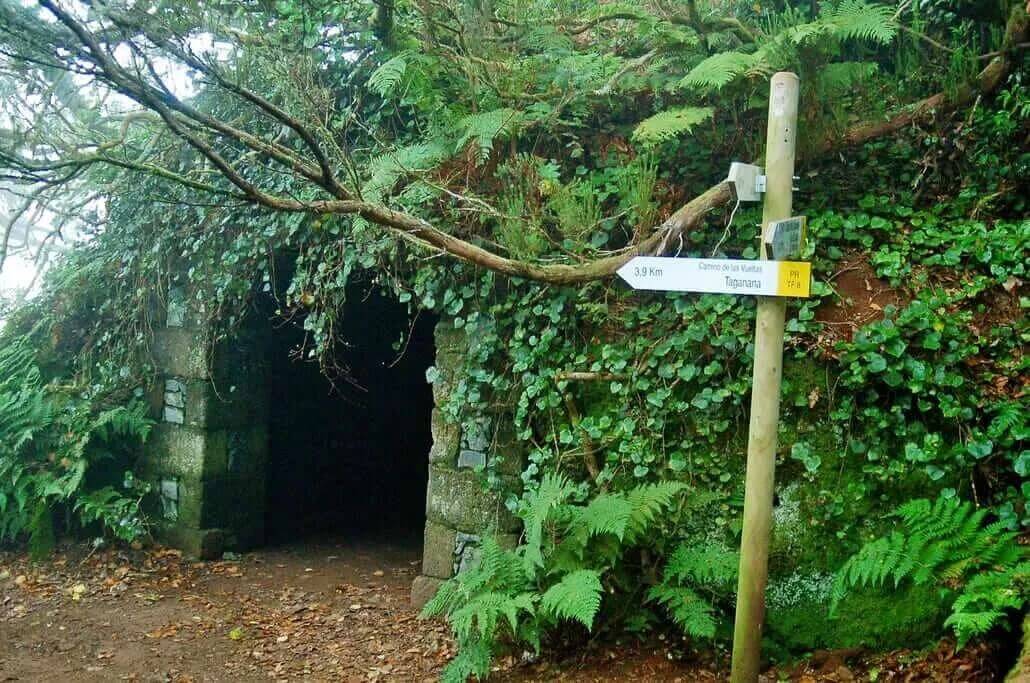
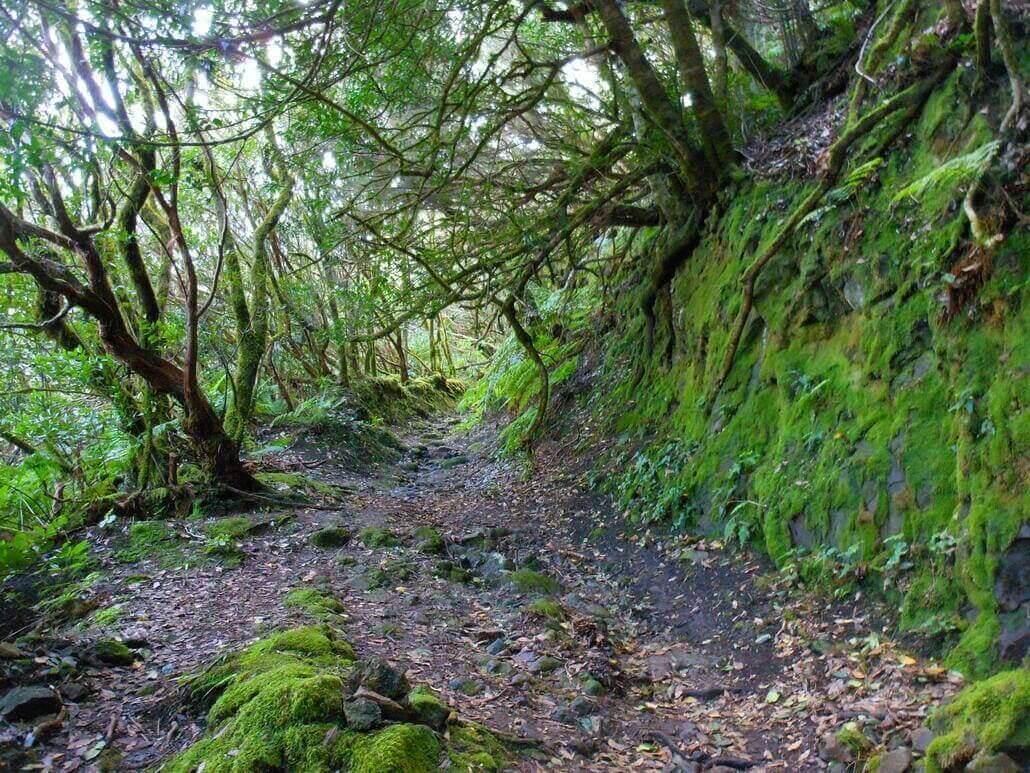
You will pass through the interior of the Laurisilva
To the right of the refuge, the PR-TF-3 path that goes to Valle Brosque enters the Laurisilva. We avoid it and follow the natural direction of the Camino Real de las Vueltas, the main path, where we immediately find two small pools of water that emerge from among the leafy ferns, which feed on the natural runoff from the slopes of the land and were used to water pack animals. You can cool off with it to feel the moist laurel forest!
The slope is minimal up to here, although a few meters further on the descent is accentuated, not becoming dangerous in this sense in any section of the path, although it must be taken into account that in the rainy season it can become a little slippery.
Further on we find a fork to the left and a narrow path that goes down to the Afur forest track. We also ignore it and continue descending along the increasingly boxed Camino Real de las Vueltas, which is covered in some sections by large specimens of Ferns that even in some cases come to cover the route.
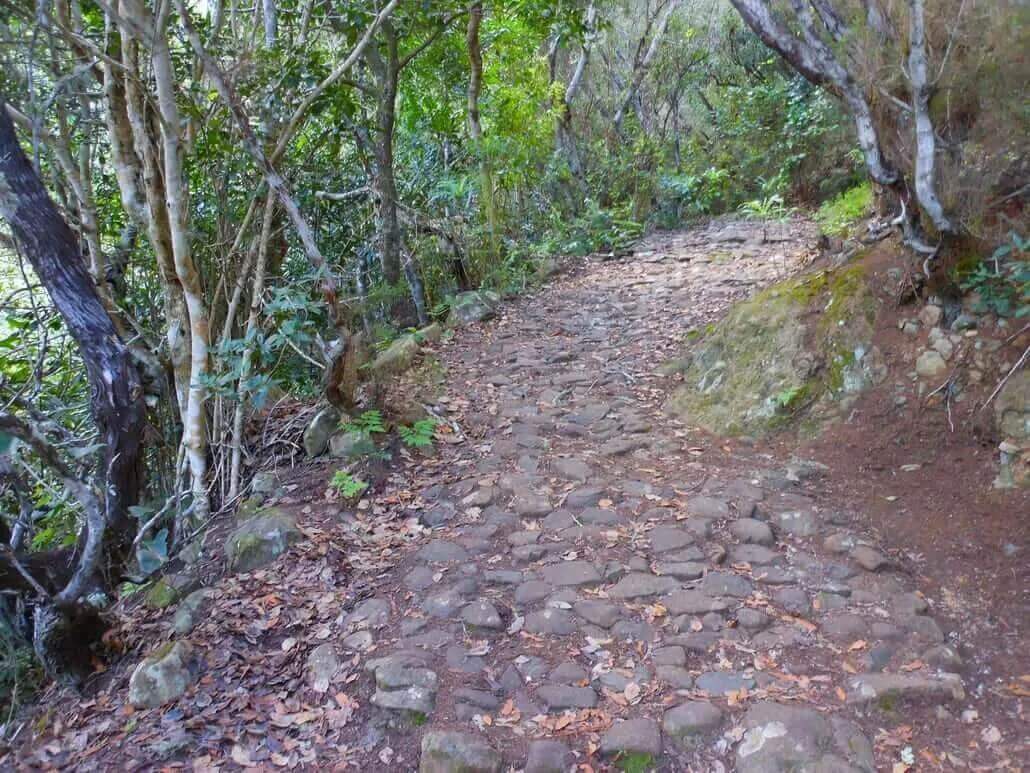
In this area we will be able to observe the original cobblestones of the trail, “Living History”. A little further on, along a small path that deviates from the main path and where large specimens of Laurels and Tiles grow: trees characteristic of the surrounding ecosystem.
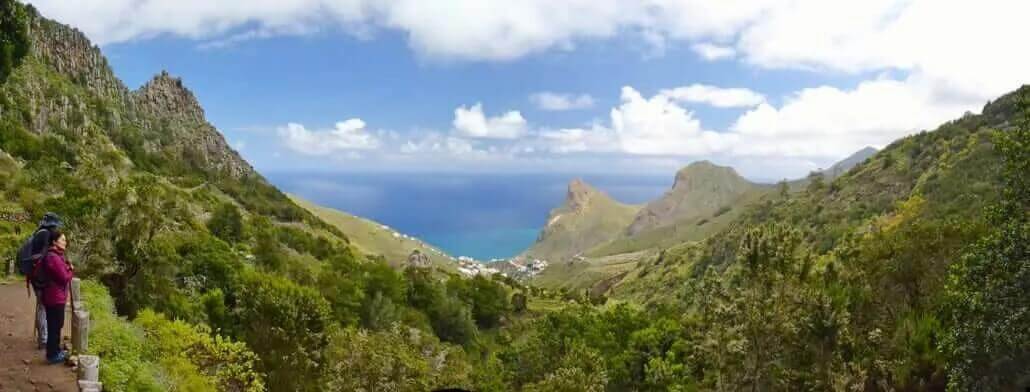
We will arrive at the Llano de las Vueltas, a place in the wide and flat forest where we can look out over a small slope to observe the magnificent landscape offered by the western part of the Anaga Massif, “Enjoy the picturesque landscape of Anaga”.
Cobbled and winding path
The path continues in a gentle descent where cobbled spaces are becoming more and more frequent and the numerous curves make us believe in the ancient legend that the path has as many turns as there are days in the year.
Continuing through Laurisilva we can observe how the Bejeques look for their place of survival on the most inaccessible slopes, specifically in the large dikes that cut through it, forming real populations and growing in the most unlikely places.
There are also Cerrajas on the sides of the road, which in the flowering season delight the eye with their spectacular colors and several species of fungi that take advantage of the moisture of the soil to grow and of course the Bicacarera, an endemic flower of the place that is not missing in this beautiful ecosystem, which with its spectacular inflorescence in the form of a small orange bell has become the main attraction of this great habitat.
“Enjoy the authentic ecosystem of the Anaga Massif” walking along the Camino Real de las Vueltas.
A little further on we will find the Descansadero de Arriba, a place where several large stones are part of the environment and little by little we will notice that the forest is becoming clearer when some crop gardens that are usually planted with potatoes and vines appear. “I’m sure a farmer will welcome you”. Large specimens of Marmolanes and Laurels, endemic tree species, characteristic of the laurel forest, grow in these places.
On the sides of the road run several secondary ravines that converge in the Barranco de la Iglesia, the latter flowing into the coast of Taganana. Among the large trees you can discover the grandiose landscape of the Roque de las Ánimas that protects the beautiful village of Taganana.
To the left rises the majestic Risco Guayosa, an impressive composite, formed by thousands of rocks superimposed on top of each other and which gives the sensation that it has been built by the hand of man. Behind us, the leafy Monte de las Vueltas bids us farewell, leaving behind its wonderful charm meandering along the Camino Real de las Vueltas. We are in the Asomada de la Virgen, a small plain delimited by logs stuck in the ground that delimit the pass.
We arrive at the Village of Taganana
Little by little we will arrive at the Barrio de Portugal, where the traditional Canarian architecture is evident during the route with a steep downhill slope. Crossing the ravine by a bridge, we will finally reach the urban center where the Church of Nuestra Señora de las Nieves is located, planted in a picturesque square surrounded by large Laurels de Indias.
Nearby is the Hermitage of Santa Catalina, declared an Asset of Cultural Interest (BIC) with the category of Monument. The Church of Nuestra Señora de las Nieves is one of the oldest in the Canary Islands (1505) and houses interesting religious works such as the Triptych of the Nativity, a Flemish panel from the sixteenth century.
If you want to know other trails on the island, visit the website of our route expert Francisco Fariña.
http://franciscoadanfarina.blogspot.com/
Facebook: Francisco A. Fariña Encinoso